

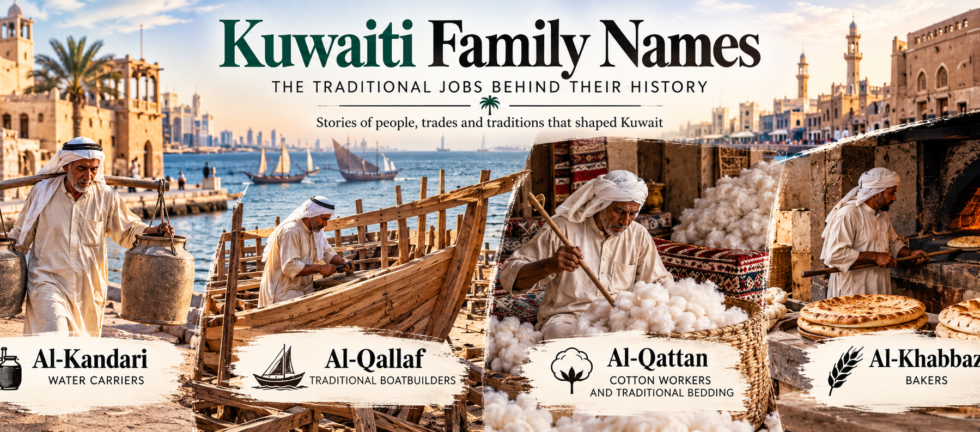
Kuwaiti Family Names: 4 Traditional Jobs Behind Their History
Your family name could tell a story about Kuwait’s past. From water carriers and traditional boatbuilders to cotton workers and bakers, familiar surnames can preserve clues about the occupations that helped communities survive and grow.
Al-Kandari, Al-Qallaf, Al-Qattan and Al-Khabbaz are examples of names traditionally associated with particular types of work. Their stories offer a glimpse into everyday life in old Kuwait, when water had to be delivered, wooden boats were built by hand, cotton was prepared for bedding, and bread was made for local communities.
A surname alone cannot prove a family’s ancestry or occupation. Individual family histories can differ, even when people share the same surname.

1. Al-Kandari: The Traditional Water Carriers
Before modern water networks supplied homes, access to freshwater was an important part of daily life in Kuwait. Water had to be collected, transported and delivered, and these tasks supported households and businesses throughout the community.
The surname Al-Kandari is traditionally associated with the kandar, a carrying pole used to transport water containers. Water carriers provided an essential service in a dry environment where reliable freshwater supplies were limited.
Water transport formed part of a wider network that included wells, storage and delivery systems. The work required physical effort and practical knowledge of how to move and distribute a valuable resource.
Read more: How Kuwait Quenched Its Thirst — Kuwait Times.
2. Al-Qallaf: Traditional Wooden Boatbuilders
Kuwait’s maritime history is closely connected with wooden boats used for fishing, trading and pearl diving. Before oil transformed the economy, these activities supported many coastal families and businesses.
The traditional craft of building wooden boats is known as qilafah, and skilled shipbuilders are called qallaleef. The surname Al-Qallaf is associated with this craft.
Building a dhow required knowledge of timber, hull construction, measurements and the sea. Boatbuilders passed skills between generations, helping supply vessels for trade and maritime work across the Gulf.

These craftspeople were an important part of Kuwait’s economic and cultural heritage. Their work helped connect the country’s ports with wider regional trading networks.
Read more: Preserving Kuwait’s Maritime Heritage — Kuwait Times.
3. Al-Qattan: Cotton Workers and Traditional Bedding
The surname Al-Qattan has a documented connection with cotton work in Kuwait. Kuwaiti newspaper reporting has described the Al-Qattan family’s involvement in cotton fluffing and the preparation of mattresses, quilts and cushions.
The traditional craft involved preparing cotton so it could be used as filling for household bedding. Workers loosened and fluffed the cotton, helping restore the shape and usefulness of mattresses and cushions.
This craft is associated with the Arabic term nadāfah, or cotton fluffing. The work required practical skill and was traditionally performed by hand.

As manufactured bedding and synthetic filling materials became more widespread, traditional cotton-fluffing work became less common. However, it remains an important part of the history of household crafts and local trades.
Read more: Al-Anba’s report about the Al-Qattan family’s traditional cotton craft.
4. Al-Khabbaz: Bakers and the Tradition of Breadmaking
Al-Khabbaz is associated with the Arabic word for a baker. Breadmaking was an important occupation because it supplied households and neighbourhoods with an everyday staple.
Traditional bread production involved preparing dough, managing an oven and baking bread for local customers. Bakers formed part of the wider food economy that connected suppliers, markets and homes.

This image should not be described as a historical photograph or as a bakery operated by an Al-Khabbaz family unless an independent source confirms that connection.
Family interviews, business records and historical photographs may help establish whether a particular branch of a family worked in baking or another food-related trade.
What These Four Names Reveal About Old Kuwait
- Al-Kandari: traditionally associated with carrying or delivering water.
- Al-Qallaf: associated with wooden boatbuilding.
- Al-Qattan: documented in Kuwait in connection with cotton fluffing and bedding.
- Al-Khabbaz: associated with the occupation of baking bread.
Together, these occupational associations illustrate how specialised work supported daily life in Kuwait. Water carriers supplied households, boatbuilders supported maritime activity, cotton workers prepared bedding, and bakers supplied food.
Does Your Family Name Tell the Whole Story?
Not necessarily. Occupational meanings can provide clues, but they cannot establish the ancestry of every person who carries a name today. A surname may have different explanations across families, and the history of one family should not automatically be applied to another.
If you want to research your own family history, speak with older relatives, record the places where your ancestors lived, and look for family documents, photographs and newspaper records. Compare oral histories with independent sources and distinguish documented facts from family traditions.
Frequently Asked Questions
Which Kuwaiti family names are associated with traditional occupations?
Examples include Al-Kandari, traditionally associated with water carrying; Al-Qallaf, associated with boatbuilding; Al-Qattan, documented in connection with cotton work; and Al-Khabbaz, associated with baking.
Does a surname prove that my ancestors had a specific job?
No. A surname can suggest an occupational association, but family records and historical sources are needed to investigate an individual family’s history.
How can I research my Kuwaiti family history?
Start with interviews with relatives, old photographs, documents and newspaper archives. Keep track of where each claim came from and seek independent confirmation where possible.
Explore More About Kuwait’s Heritage
Discover more about Kuwait’s traditional trades in Olden Kuwait’s Industrious Spirit and learn about the country’s maritime history in Preserving Kuwait’s Maritime Heritage.
Editorial and image note: Occupational associations are not proof of shared ancestry. The cotton image is a historical illustration from India, not Kuwait. Check the image licences and upload permitted images to WordPress for reliable display.