

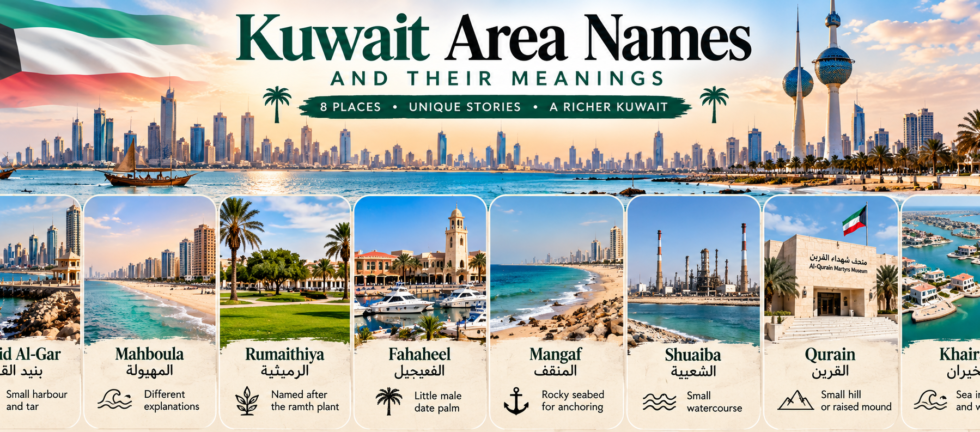
Kuwait Area Names and Their Meanings: 8 Places Explained
Discover the stories behind eight Kuwaiti areas, their Arabic names, and the landscapes and traditions associated with them.
Kuwait’s place names preserve stories about coastal life, desert plants, hills and waterways. Some origins have several interpretations, so the explanations below distinguish commonly reported meanings from confirmed historical facts.
1. Bneid Al-Gar (بنيد القار) — Small Port of Tar

One explanation connects Bneid Al-Gar with a small harbour and tar. Bunaydar is associated with a small port, while qar refers to tar or pitch. The name has also been linked to oily or tar-like deposits along Kuwait’s coast.
Meaning commonly reported: Small port associated with tar.
Image source: Kuwait Tourist Enterprises Company · Place-name reference
2. Mahboula (المهبولة) — Local Stories Behind the Name

Mahboula is a coastal residential area in southern Kuwait. Different explanations have been offered for its name, including stories connected with the local landscape and the way rainwater once moved through the area.
Because these explanations differ, it is better to present them as local stories and reported interpretations rather than as one confirmed translation.
Key point: Mahboula’s name has multiple reported explanations.
Photo credit: Faustine Sharky, Wikimedia Commons. Licensed under CC BY-SA 4.0. Image cropped for this article.
View Mahboula image and licence · Place-name reference
3. Rumaithiya (الرميثية) — The Rimth Desert Plant

The name Rumaithiya is commonly associated with rimth, a desert plant that grows in dry environments. Before modern roads and housing changed the landscape, desert vegetation could provide grazing areas for camels and other animals.
This reported explanation connects the neighbourhood’s name with plants that once grew in the surrounding landscape. The photograph illustrates desert vegetation, not a verified photograph of historic Rumaithiya.
Meaning commonly reported: A name associated with the rimth desert plant.
4. Fahaheel (الفحيحيل) — The Male Date Palm
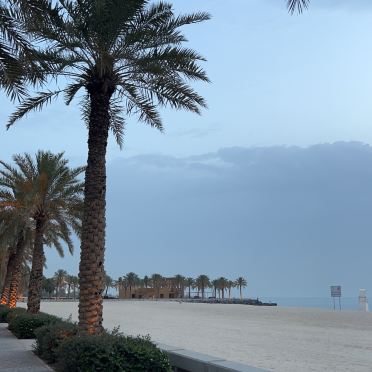
Fahaheel is a historic coastal town in southern Kuwait. One explanation traces its name to fahal, meaning a male date palm.
Accounts of the area’s past also mention groundwater and date palms growing near the coast. Fahaheel’s heritage is associated with Kuwait’s traditional fishing, pearling and maritime communities.
Meaning commonly reported: Male date palm.
Image source: Fahaheel travel photographs · Kuwait place-name reference
5. Mangaf (المنقف) — Two Reported Explanations

Two explanations are reported for the name Mangaf. One connects it with raised ground where an old settlement stood near the sea. Another refers to a rocky seabed where ships’ anchors could struggle to hold. These are alternative interpretations rather than one confirmed meaning.
Meanings reported: Raised ground or a rocky seabed.
Photo source: Indians in Kuwait — A Visit to Mangaf Beach · Place-name reference
6. Shuaiba (الشعيبة) — Small Stream

The name Shuaiba is associated in one account with a small stream or watercourse. Rainwater could flow down from higher ground, pass through the old village and continue towards the sea.
The same historical account mentions underground water storage and freshwater wells. The old settlement was later transformed by industrial development.
Meaning reported: Small stream or watercourse.
Image and historical source: Al Jarida
7. Qurain (القرين) — Small Hill

Qurain is commonly explained as a diminutive form of the Arabic word qarn, which can refer to a horn or a prominent hill. Under this interpretation, Qurain means a small hill or mound rising above flatter land.
The name is also associated with Al-Qurain Martyrs Museum, which commemorates Kuwaiti resistance during the Iraqi occupation of 1990–1991.
Meaning commonly reported: Small hill or raised mound.
Image source: Al Anba · Read about Al-Qurain Martyrs Museum
8. Khairan (الخيران) — Sea Inlets

Khairan is a coastal destination in southern Kuwait. Its name is commonly connected with the plural of khor, an Arabic word for a sea inlet or narrow stretch of water extending into the land.
The waterways and coastal inlets are distinctive features of Khairan’s geography. The area is also known for waterfront chalets and seaside leisure.
Meaning commonly reported: Sea inlets or waterways.
Image and destination reference: Kuwait Times
What Kuwait’s Place Names Tell Us
These eight examples show how geography, vegetation, water and coastal life can influence place names. Some origins have more than one interpretation, so historical accounts and local traditions should be compared rather than treating every explanation as certain.
Explore More About Kuwait
Editorial note: Meanings in this article are based on reported linguistic explanations and local historical accounts. Interpretations can differ. Check image sources’ reuse and attribution requirements before republishing.