

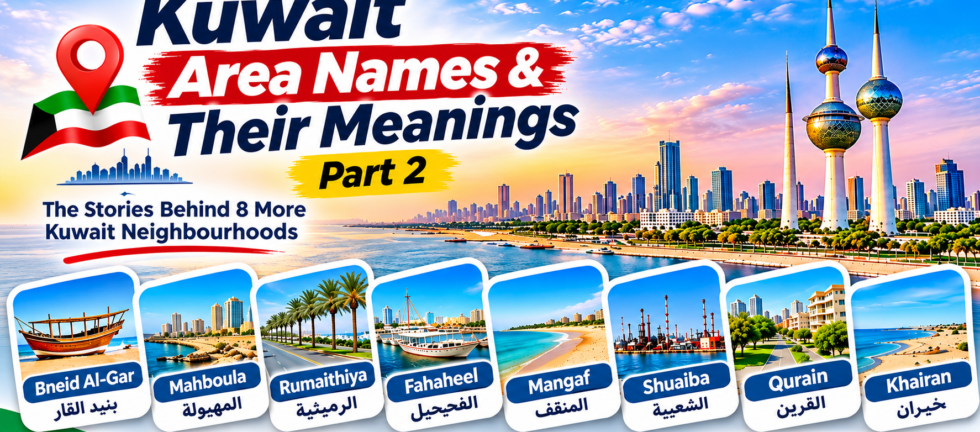
Kuwait Area Names and Their Meanings – Part 2
Have you ever wondered how Kuwait’s neighbourhoods got their names? Behind many familiar area names are fascinating stories about old wells, farms, natural landscapes and the people who once lived there.
Some names are connected to the environment, while others are believed to have originated from the names of local residents. From Abu Halifa to Khaitan, every neighbourhood has a story worth discovering.
In this third part of our Kuwait area names series, we explore the possible meanings and traditional stories behind eight more neighbourhoods.

Modern Gulf city scenery introducing Kuwait’s changing landscape.
In This Article
- Abu Halifa
- Egaila
- Hawalli
- Messila
- Jleeb Al-Shuyoukh
- Farwaniya
- Mishref
- Khaitan
- Frequently Asked Questions
1. Abu Halifa (أبو حليفة)

Abu Halifa is a coastal neighbourhood in southern Kuwait. One local explanation connects its name to a type of wild grass known as Halfa.
According to this interpretation, the name refers to a place where Halfa grass grew. The expression is sometimes understood as describing a place with small or plentiful Halfa plants.
There are other explanations for the origin of Abu Halifa, so the plant-related story is best understood as one traditional interpretation rather than a confirmed historical fact.
2. Egaila (العقيلة)

One local explanation connects the name Egaila with the Arabic word Uqla, referring to a small well where water could be found close to the surface.
According to this story, the water was shallow enough that only a short rope was needed to draw it. The explanation also connects the name with the rope used to hobble a camel.
This traditional account reflects the importance of wells, animals and water sources in everyday life in old Kuwait. The exact origin of the name has not been conclusively established.
3. Hawalli (حولي)

Hawalli is one of Kuwait’s well-known residential and commercial areas. One historical account connects its early development to the discovery of sweet water in a farm well around 1906.
According to this story, the farm was associated with a man named Hawalli bin Marzouq Al-Azmi. As people began referring to the location by the name associated with the farm and its owner, the name Hawalli became established.
Another explanation connects the name with the Arabic word Helw, meaning sweet, referring to the quality of the water. Different local accounts exist about the name’s origin.
4. Messila (المسيلة)

The name Messila is traditionally associated with the Arabic word Sail, meaning flowing water or a flood.
One explanation suggests that rainwater used to flow across the land towards the sea. As the water moved through the area and eventually dried, it left behind salty ground or salt flats.
This interpretation connects the name with the natural landscape and the movement of rainwater before modern development transformed the area.
5. Jleeb Al-Shuyoukh (جليب الشيوخ)

The name Jleeb Al-Shuyoukh is commonly translated as “the well of the sheikhs.” The word Jleeb is associated with Kuwaiti dialect and the Arabic word Qaleeb, meaning a well.
According to a traditional historical account, the name is connected to a well dug by Sheikh Mohammed and Sheikh Jarrah Al-Sabah, who were brothers of Sheikh Mubarak Al-Sabah.
Over time, the well became associated with the sheikhs, and the name Jleeb Al-Shuyoukh came to identify the surrounding area.
6. Farwaniya (الفروانية)

Farwaniya has an interesting story involving several names. According to one local account, the area was once known as Matla’ Ayyad. It was later associated with the name Al-Dougha, linked to plaster-making activity that took place there.
The story explains that plaster makers used fires during their work, leaving pits and marks on the ground.
In 1962, the area became known as Farwaniya, named after Surour bin Farwan Al-Mutairi, who lived there and dug a well. This account connects the modern name with an early resident of the area.
7. Mishref (مشرف)

The name Mishref is often associated with the Arabic meaning of overlooking or having a view from a higher place.
One traditional explanation says the area had a raised piece of land or mound overlooking greener surroundings. The elevated location is also associated in local stories with a palace built by Sheikh Mubarak Al-Sabah.
This interpretation connects the name with the area’s landscape and its elevated position. Other accounts offer different explanations, so the origin remains a matter of local historical interpretation.
8. Khaitan (خيطان)
According to a popular local story, Khaitan was named after a farmer called Khaitan Al-Otaibi.
The story says that he built a house and dug a well in the area. As more people came to the well to collect water, they began referring to the location as the place of Khaitan, or simply Khaitan.
Over time, the name became associated with the wider neighbourhood. This story highlights how the names of early residents and important water sources helped shape the identity of Kuwait’s older settlements.
What These Names Tell Us About Kuwait
From wells and farms to coastal landscapes and traditional occupations, these place names offer a glimpse into Kuwait’s past.
Many neighbourhoods began as small settlements shaped by water sources, agriculture, family histories and the natural environment. Their names preserve memories of a time when wells, farms and local landmarks played an important role in everyday life.
Some explanations have more than one version, and local traditions do not always agree. That makes researching these names even more interesting: every neighbourhood may hold stories passed down through generations.
Explore More Kuwait History and Places
Interested in learning more about Kuwait’s history, famous landmarks and neighbourhoods? Explore these related articles from HussainHK:
-
Kuwait Area Names and Their Meanings – Part 1
– Discover the stories behind Bneid Al-Gar, Mahboula, Rumaithiya, Fahaheel and other areas. -
Kuwait Towers: History and Interesting Facts
– Explore one of Kuwait’s most recognisable landmarks. -
Souq Sharq Kuwait: Its History and Waterfront Story
– Learn about the history of this famous waterfront destination. -
Flamingo Season in Kuwait: Best Time and Where to See Them
– Discover Kuwait’s coastal wildlife and natural habitats.
Frequently Asked Questions About Kuwait Area Names
1. Why do Kuwait’s neighbourhoods have unusual names?
Many Kuwaiti neighbourhood names are connected to historical events, local residents, traditional occupations, wells, farms, plants and geographical features. Some names have several possible explanations passed down through generations.
2. What does Abu Halifa mean in Kuwait?
One traditional explanation connects Abu Halifa with Halfa, a type of wild grass that reportedly grew in the area. Other explanations also exist.
3. What is the meaning of Egaila in Kuwait?
One local account connects Egaila with the Arabic word Uqla, referring to a small well where water was close to the surface and could be drawn using a short rope.
4. How did Hawalli get its name?
One account links Hawalli to a farm and a well associated with Hawalli bin Marzouq Al-Azmi. Another explanation connects the name with sweet water.
5. What does Messila mean?
Messila is traditionally associated with the Arabic word Sail, meaning flowing water or a flood.
6. Why is it called Jleeb Al-Shuyoukh?
Jleeb Al-Shuyoukh is commonly interpreted as the well of the sheikhs. A traditional account connects the name with a well dug by Sheikh Mohammed and Sheikh Jarrah Al-Sabah.
7. Who was Farwaniya named after?
One historical account says Farwaniya was named after Surour bin Farwan Al-Mutairi, an early resident associated with the area.
8. What does Mishref mean in Arabic?
Mishref is commonly associated with the idea of overlooking or having a view from an elevated location.
9. Who was Khaitan named after?
A popular local account connects Khaitan with a farmer named Khaitan Al-Otaibi, who reportedly built a house and dug a well in the area.
10. Where can I read about more Kuwait area names?
You can explore our Kuwait Area Names and Their Meanings – Part 1 article for more neighbourhood histories and traditional explanations.
Historical note: The explanations in this article are based on traditional local accounts and published descriptions. Not every name origin has been independently confirmed by historical records. The photographs are illustrative scenery and are not claimed to show the exact historical locations described.
Explore More About Kuwait
Continue exploring the stories behind Kuwait’s neighbourhoods, landmarks, traditions and history through our other articles on HussainHK.
Which Kuwait area name would you like us to explore next? Share your thoughts in the comments.