

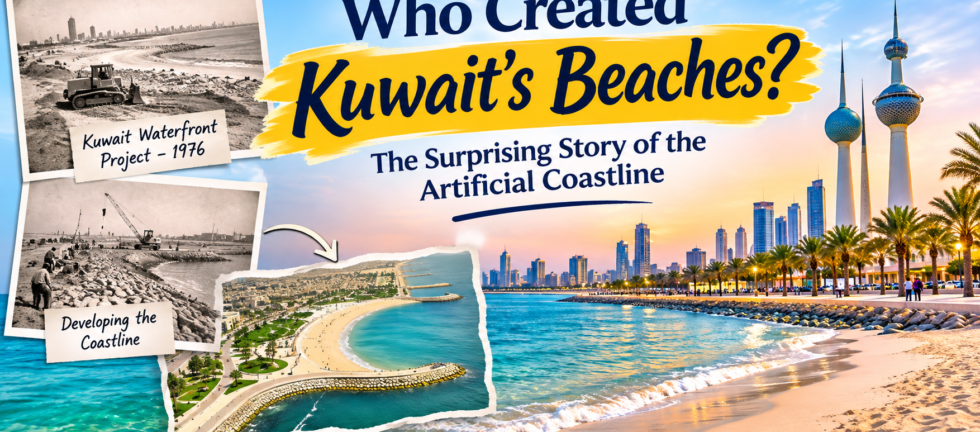
If you have ever driven along Gulf Road in Kuwait City, you have probably noticed the beautiful coastline, public beaches and waterfront attractions.
For many people, these beaches have always been part of Kuwait’s landscape. Families visit them, children play in the sand, and people enjoy evening walks while looking out towards the Arabian Gulf.
But here is something surprising: some of the beaches you see today were deliberately designed and constructed by engineers.
The sand beneath your feet may not have been placed there entirely by nature.
The story goes back to 1976, when Kuwait began planning one of its most ambitious waterfront development projects. What followed was a major transformation of the city’s coastline, creating artificial beaches, promenades, parks and even an artificial island.
So, who created these beaches, and why did Kuwait need them?
Let’s explore the fascinating story behind Kuwait City’s coastline.
1. Kuwait’s Coastline Before the Waterfront Project
Before Kuwait City became the modern urban destination we know today, its relationship with the sea was very different.
Historically, the coastline was central to everyday life. Fishing, pearl diving, dhow building and maritime trade played important roles in Kuwait’s economy and culture.
However, as the country developed following the discovery of oil, Kuwait City expanded rapidly.
New buildings, roads, commercial areas and residential developments began changing the urban landscape.
The coastline also experienced significant changes through reclamation, construction and other development activities.
By the 1970s, there was a growing need to improve the waterfront and create more attractive recreational spaces for residents.
The idea was not simply to build more structures along the sea. It was to create a waterfront where people could enjoy public spaces, beaches and leisure facilities.
2. It All Started in 1976: The Kuwait Waterfront Project
The transformation of Kuwait City’s waterfront began taking shape in the mid-1970s.
In 1975, the Kuwait Municipality organised an international design competition for the development of approximately 21 kilometres of the city’s waterfront.
The project was intended to transform the coastline into a more accessible and attractive public space.
Planning and design work began in 1976.
The project involved international architects, coastal engineers and local specialists who worked together to understand Kuwait’s coastal conditions.
The development included several major features:
● Artificial recreational beaches.
● Seaside promenades.
● Public parks and landscaped areas.
● Waterfront entertainment facilities.
● Marina and boating facilities.
● An artificial island.
The aim was to create a waterfront that reflected Kuwait’s coastal heritage while providing modern recreational facilities for its growing population.
3. Who Actually Built Kuwait’s Artificial Beaches?
Creating a beach is not as simple as dumping sand beside the sea.
Coastal engineers must consider tides, waves, water movement, sand movement and the shape of the shoreline.
This was particularly important in Kuwait because of its relatively high tidal range.
A research paper published by Timothy W. Kana, Mohammad Al-Sarawi and Michael Holland in 1986, titled Design and Performance of Artificial Beaches for the Kuwait Waterfront Project, explains how the beaches were planned and engineered.
The researchers describe eight pocket beaches constructed as part of the waterfront development.
These beaches were designed to provide recreational spaces while accounting for the local coastal environment.
The project required detailed studies of coastal processes and beach conditions before the final designs could be implemented.
Planning began in 1976, and the first phases of construction were completed in 1985.
This means that the beaches were not simply natural formations left untouched. They were part of a carefully planned engineering project.
4. Why Did Kuwait Need Artificial Beaches?
One important reason was the need to create better recreational spaces for the public.
Kuwait’s coastal environment has particular characteristics that make beach development challenging.
One of the biggest considerations is the tidal range, which can reach approximately 3.5 metres in Kuwait Bay.
This means that the amount of exposed beach can change significantly between high and low tides.
The engineers needed to design beaches that could remain suitable for recreational use despite these conditions.
The artificial beaches were therefore designed with specific shapes and coastal protection measures.
The waterfront project also aimed to improve public access to the sea and replace less attractive sections of the coastline with landscaped recreational areas.
In other words, the project was about much more than creating a place to swim.
It was about giving Kuwait City a waterfront that people could enjoy.
5. The Transformation of 20 Kilometres of Coastline
One of the most impressive aspects of the Kuwait Waterfront Project was its scale.
The development extended along approximately 20 kilometres of Kuwait City’s coastline.
The first two phases included a major stretch of developed waterfront, with beaches, promenades, recreational facilities and public attractions.
According to historical accounts of the project, the first two phases were completed in 1985.
The development helped transform the appearance of Kuwait City’s eastern coastline.
Areas that had previously been affected by earlier reclamation and coastal development were redesigned to provide more attractive public spaces.
Today, the waterfront remains an important part of the city’s identity.
6. What About the Artificial Island?
Another fascinating element of Kuwait’s waterfront development was the inclusion of an artificial island.
The project incorporated an artificial island approximately 400 metres in diameter.
It was part of the wider plan to introduce new recreational and waterfront features along the coastline.
Kuwait is also home to Green Island, a well-known artificial island along the waterfront that opened in 1988.
Green Island became a popular recreational attraction, offering landscaped areas, walking spaces and leisure facilities.
It is a reminder of how far Kuwait went in transforming parts of its coastline into places for public recreation.
7. Can You Still See the Results Today?
Absolutely!
Many of the waterfront attractions that residents and visitors enjoy today are connected to Kuwait’s long history of coastal development.
Some familiar examples include:
Kuwait Towers
One of the country’s most recognisable landmarks, located along the waterfront.
Green Island
An artificial island developed as a recreational attraction, offering green spaces and seaside views.
Kuwait Waterfront
A long stretch of developed coastline with public spaces, walking areas and recreational attractions.
Gulf Road
One of Kuwait City’s most familiar coastal routes, running alongside the Arabian Gulf and connecting several important waterfront locations.
These attractions show how the coastline has evolved alongside the city’s growth.
8. A Different Way to Look at Kuwait’s Beaches
The next time you visit a beach along Kuwait City’s waterfront, take a moment to look around.
The sand, shoreline, protective structures and surrounding recreational spaces may represent decades of engineering, planning and development.
What looks like a simple beach is sometimes the result of years of research and coastal design.
And that is what makes Kuwait’s waterfront story so interesting.
The sea provided the setting, but human planning helped shape many of the recreational beaches that people enjoy today.
Frequently Asked Questions (FAQs)
1. Are Kuwait City’s beaches artificial?
Some of the recreational beaches along Kuwait City’s waterfront were deliberately designed and constructed as part of the Kuwait Waterfront Project. However, not every beach in Kuwait is artificial.
2. When did Kuwait start developing artificial beaches?
Planning for the major Kuwait Waterfront Project began in 1976. The first phases of construction were completed in 1985.
3. How many artificial beaches were constructed?
A coastal engineering research paper by Kana, Al-Sarawi and Holland describes eight pocket beaches constructed as part of the waterfront project.
4. Why were artificial beaches needed in Kuwait?
The beaches were designed to improve public recreational facilities and address local coastal conditions, including Kuwait Bay’s relatively high tidal range.
5. Is Green Island in Kuwait artificial?
Yes. Green Island is an artificial island along Kuwait’s waterfront. It opened in 1988.
6. How long is the Kuwait Waterfront Project?
The main waterfront development was planned along approximately 20 kilometres of Kuwait City’s coastline.
7. Who designed Kuwait’s Waterfront Project?
The project involved several local and international specialists. Sasaki Associates was selected to prepare the detailed master plan, working alongside other design and engineering professionals.
Conclusion: The Beach You Know Has a Story You Never Knew
Kuwait’s beaches are more than just places to relax, swim and enjoy the sea.
They are also part of an interesting engineering and urban development story that began nearly five decades ago.
From the planning work that started in 1976 to the artificial beaches and recreational spaces developed along the coastline, Kuwait’s waterfront has undergone a remarkable transformation.
So, the next time you drive along Gulf Road or spend an evening at the beach, remember that some of the sand beneath your feet is part of a much bigger story.