

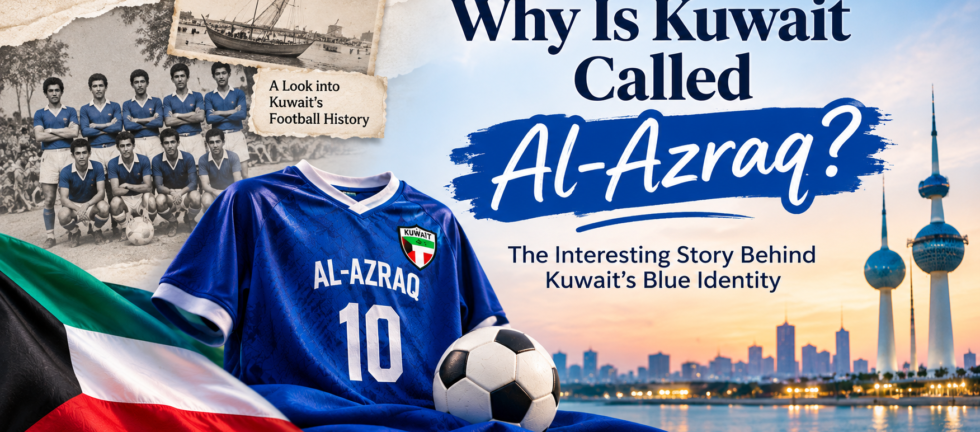
Look at the Kuwaiti national flag. You will see four colours: green, white, red and black. There is no blue anywhere.
Yet, ask a football fan about Kuwait, and one of the first words you might hear is Al-Azraq (الأزرق) – The Blues.
Kuwait’s national football team is widely recognised by this nickname. Blue jerseys, blue football merchandise and the identity of Al-Azraq have become familiar symbols of Kuwaiti football.
But here is an interesting question: If blue is not part of the national flag, how did it become so closely associated with Kuwait?
The answer takes us into the history of Kuwaiti football, sporting traditions and the evolution of national identity.
1. What Does Al-Azraq Mean in Kuwait?
Al-Azraq is an Arabic word meaning ‘The Blue’.
It is the famous nickname of Kuwait’s national football team. Over the years, the blue football kit has become a recognisable part of the country’s sporting identity.
For generations of football supporters, Al-Azraq has represented more than just the colour of a shirt. It brings back memories of international competitions, historic victories and the pride of watching Kuwait compete on the football field.
The nickname is now strongly associated with Kuwaiti football and is recognised by football followers across the Gulf region.
2. Kuwait’s Football History Goes Back Further Than You Think
Football did not suddenly appear in Kuwait during the 1950s.
According to historical accounts, the sport began developing in the country during the early 1930s. Kuwaiti merchants travelling between India and Kuwait were among those who became familiar with the game.
As interest grew, local sporting clubs began emerging. Football gradually became an important part of the country’s sporting culture.
Some important milestones include:
● 1932: Football began developing as an organised sport in Kuwait.
● 1951: The first football league involving local clubs began.
● 1952: The Kuwait Football Association was founded.
● 1961: Kuwait played its first recorded international match against Libya in Morocco.
● 1980: Kuwait won the AFC Asian Cup.
● 1982: Kuwait made its historic debut at the FIFA World Cup in Spain.
These milestones help explain how football developed into one of Kuwait’s most celebrated sporting traditions.
3. The 1954 Football Shirt Theory: Where Did the Blue Begin?
One interesting theory circulating online suggests that Kuwait’s association with blue may have started with a football shirt in 1954.
It is an intriguing possibility, particularly because the 1950s were an important period in the development of organised football in Kuwait.
However, there is an important distinction between a popular historical theory and a documented fact.
Although Kuwait’s football movement was growing during this period, there is no reliable historical confirmation establishing 1954 as the exact year when the national team’s blue identity began.
The Kuwait Football Association’s historical records establish the growth of football and the team’s later international journey, but they do not clearly document the origin of the blue shirt.
What we do know is that blue eventually became the defining colour of Kuwait’s national football team.
And that identity has lasted for generations.
4. Why Doesn’t Kuwait’s National Flag Have Blue?
Kuwait’s current national flag was officially adopted in 1961, following the country’s independence.
It consists of three horizontal stripes and a black trapezoid on the left side.
Here is what the four colours represent:
|Colour|Symbolism |
|——|———————————|
|Green |Fertile land and fields |
|White |Good deeds and purity |
|Red |Courage, struggle and bloodshed |
|Black |Battles and the defeat of enemies|
The colours are inspired by a famous Arabic poem attributed to Safi Al-Din Al-Hilli.
Interestingly, the country’s national flag and its football team’s colours serve different purposes. The flag represents the country’s national symbolism, while blue became associated with its sporting identity.
That is why you can see Kuwaiti football supporters proudly wearing blue even when the national flag itself contains no blue.
5. The Blue Identity and Kuwait’s Football Glory
If there is one period that helped strengthen Kuwait’s blue football identity, it is the country’s golden era in football.
Kuwait achieved one of its greatest sporting accomplishments in 1980 when the national team won the AFC Asian Cup.
The victory was a historic moment for Kuwaiti football and brought international recognition to the country.
Two years later, Kuwait qualified for the 1982 FIFA World Cup in Spain.
It was the country’s first appearance in the tournament.
For football supporters, this was much more than participation in an international competition. It was an opportunity for Kuwait to showcase its sporting talent on the world’s biggest football stage.
The blue jersey became an instantly recognisable sight during this historic journey.
Even today, the memories of Kuwait’s golden football years remain an important part of the country’s sporting heritage.
6. Blue Beyond Football: What Else Represents Kuwait?
Football may be the strongest association with Al-Azraq, but Kuwait has other interesting connections to blue.
The Arabian Gulf
Kuwait has a long maritime history. Fishing, pearl diving, boat building and sea trading were once central to the lives of many Kuwaitis.
The blue waters of the Arabian Gulf are an important part of the country’s natural landscape and heritage.
The Traditional Dhow
The dhow is one of the most recognisable symbols of Kuwait’s maritime past. Traditional wooden boats were used for fishing, pearl diving and trading.
Interestingly, the dhow also appears in Kuwait’s national emblem, connecting the country’s official symbolism with its maritime heritage.
The Kuwait Waterfront
From the coastline to the islands, the sea remains an important part of Kuwait’s identity. Blue is a natural visual association with the country’s coastal environment.
Although these connections do not establish the historical origin of Al-Azraq, they show why blue feels so familiar in the Kuwaiti setting.
7. Is Al-Azraq Still an Important Part of Kuwait Today?
Absolutely.
The name Al-Azraq continues to be used when referring to Kuwait’s national football team.
For football supporters, the blue shirt represents national pride, sporting history and memories of some of Kuwait’s greatest achievements.
The team’s history also reminds people of the country’s contribution to Asian football, particularly during the 1970s and 1980s.
While football has changed significantly over the decades, the nickname Al-Azraq remains one of the most recognisable sporting identities in Kuwait.
Conclusion: A Colour That Became Part of Kuwait’s Identity
Kuwait’s national flag may not contain blue, but that has never stopped blue from becoming one of the country’s most recognisable sporting colours.
Through the national football team, the name Al-Azraq has grown into an identity associated with pride, memories and sporting heritage.
The exact historical beginning of the blue football shirt still deserves further research, particularly the interesting 1954 theory.
But one thing is certain: when people talk about Al-Azraq, they are talking about much more than a colour. They are talking about Kuwait’s football history.
And perhaps that is why Kuwait will always be associated with blue, even when its flag says otherwise.
Frequently Asked Questions (FAQs)
1. Why is Kuwait called Al-Azraq?
Al-Azraq means ‘The Blues’ in Arabic. It is the nickname of Kuwait’s national football team because of its blue playing kit.
2. Does Kuwait’s national flag have blue?
No. Kuwait’s national flag consists of green, white, red and black. It does not contain blue.
3. When was the Kuwait national football team established?
The Kuwait Football Association was founded in 1952. The national team played its first recorded international match against Libya on 3 September 1961.
4. Did Kuwait win the Asian Cup?
Yes. Kuwait won the AFC Asian Cup in 1980, one of the greatest achievements in the country’s football history.
5. When did Kuwait participate in the FIFA World Cup?
Kuwait made its first FIFA World Cup appearance in 1982 in Spain.
6. Why is blue associated with Kuwait?
Blue is primarily associated with Kuwait through its national football team, popularly known as Al-Azraq. The precise historical origin of the team’s blue kit has not been conclusively established.