

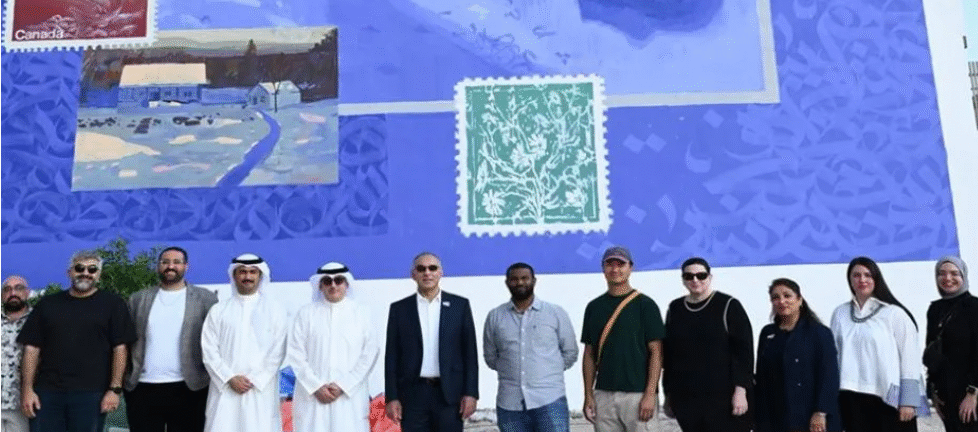
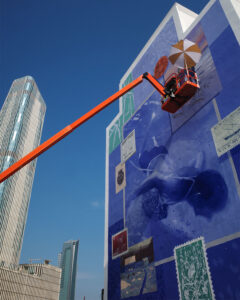
If you’ve been driving around Sharq recently, you might have noticed a striking new mural quietly taking shape near the police station roundabout. I passed by while the final touches were still being applied, and it’s already one of the most meaningful public artworks I’ve seen in Kuwait this year.
The mural is part of a cultural initiative by the National Council for Culture, Arts and Letters under a project called “Al Fenn Al Thalith Murals Project”, which roughly translates to “The Third Art Murals Project.” This program focuses on using large-scale murals as a way to connect art, culture, and daily urban life.
What makes this mural special is that it’s not only a Kuwaiti project — it’s also part of a cultural exchange. This particular piece was created in collaboration with the Canadian Embassy in Kuwait and features a joint effort between Canadian artist Bryan Beyung and Kuwaiti artist Yousef Saleh, with implementation assistance from artist Laila Naseeb.
What the Mural Represents
At first glance, the artwork is visually powerful — but once you understand the concept behind it, the mural becomes even more impressive.
The main theme of the mural is water as a connection between cultures. Water is shown not just as an element of nature, but as a symbolic force that links people, history, and identity across borders.
The artists drew inspiration from the classic Kuwaiti film Bas Ya Bahar and the heritage of pearl diving, which once defined coastal life in Kuwait. You’ll notice different scenes blending into one another — including references to marine life, shared traditions, and environmental storytelling.
Some of the most emotional elements include:
-
A father and daughter ice fishing
-
Shared marine species from different parts of the world
-
Symbols like postage stamps and seashells
-
Kuwait’s iconic Arfaj flower
-
Flowing Arabic calligraphy running through the composition
All of these elements come together to reflect ideas of home, memory, movement, and cultural exchange. The water in the mural doesn’t stay still — it flows visually across the walls, just like stories and traditions flow between cultures and generations.
Part of a Bigger Cultural Program
This mural isn’t a one-off project. It’s the third installation in the Cultural Exchange Program.
The first mural was created in collaboration with the British Embassy, followed by a second project with the Australian Embassy. This ongoing series makes Sharq one of the most quietly artistic districts in the city without many people even realizing it.
It’s honestly refreshing to see public spaces in Kuwait being transformed into open-air galleries like this.
Where You Can Find It
If you want to check it out yourself, the mural is located:
Sharq, near the police station roundabout.
When I visited, the artists were still adding finishing details before the official reveal — so if you pass by now, you’ll likely see the completed version in all its color and detail.
Whether you’re into photography, street art, or just enjoy discovering hidden cultural spots around Kuwait, this mural is definitely worth the drive.
This mural is part of a long-term vision by Kuwait’s cultural authorities to integrate art directly into public spaces instead of keeping it limited to galleries and exhibitions. Through the Al Fenn Al Thalith Murals Project, the goal is to make art accessible to everyone — commuters, families, tourists, and residents — without needing a ticket or a venue.
By placing the artwork in Sharq, a business and residential hub, the project turns everyday surroundings into cultural landmarks. It also encourages people to slow down, observe, and reflect rather than simply pass by.
What makes this project particularly meaningful is that each mural in the series focuses on cross-cultural dialogue. Instead of decorative art, each work carries educational, historical, and emotional value — showing that art can communicate ideas that go far beyond words.
Why Cultural Murals Matter in Kuwait
Public murals like this one represent an important shift in how culture is shared in Kuwait. In a fast-developing city, it’s easy to overlook history, memory, and identity. Murals help preserve these values visually by:
-
Celebrating Kuwait’s heritage in a modern format
-
Encouraging younger generations to connect with local history
-
Introducing international influences without losing cultural identity
-
Adding creative character to urban spaces
Kuwait’s art scene is slowly growing, and initiatives like this show a genuine commitment to building a culturally rich city rather than just a modern one.
Best Time to Visit the Mural
If you plan to visit:
-
Morning is ideal for photography due to softer natural light
-
Evening gives the mural a dramatic look with street lighting
-
Avoid peak traffic hours to park nearby comfortably
Bring a wide-angle lens or phone camera — the artwork stretches across a large surface and captures more detail when photographed from a distance.
FAQs – Sharq Mural in Kuwait
Where exactly is the mural in Sharq?
The mural is located near the police station roundabout in Sharq. It’s visible from the roadside, so you don’t need to enter any building to view it.
Is there an entry fee to see the mural?
No. The mural is located in public space and is free for everyone to view and photograph.
Who were the artists behind the mural?
The mural is a collaboration between Canadian artist Bryan Beyung and Kuwaiti artist Yousef Saleh, implemented with assistance from artist Laila Naseeb.
What is the theme of the mural?
The central theme is water as a symbolic element representing connection, memory, and cultural exchange between nations.
Is this part of a larger project?
Yes. This mural is the third installation under Kuwait’s Cultural Exchange Program following previous collaborations with the British and Australian embassies.
Can I take photos and post online?
Yes. Since it’s in a public area, photography is allowed. Tagging the artists or project page on Instagram is encouraged if you share images on social media.
Are there more murals planned in Kuwait?
The Cultural Exchange Program suggests that more installations are likely in the future, especially with continued embassy collaborations.
Final Thought
What I loved most about this mural is that it doesn’t demand attention — it earns it. You notice it slowly, absorb it naturally, and walk away thinking about it long after you leave.
If you’re someone who enjoys discovering meaningful places rather than just popular spots, this artwork is worth your time. It reminds us that culture doesn’t only belong inside museums — sometimes it lives right on the street corner.